I. First: THE LAW OF GOD MUST BE PERPETUAL. There is no abrogation of it, nor amendment of it. It is not to be toned down or adjusted to our fallen condition; but every one of the Lord's righteous judgments abideth forever. I would urge three reasons which will establish this teaching.

Jesus did not come to change the law, but he came to explain it, and that very fact shows that it remains, for there is no need to explain that which is abrogated. Upon one particular point in which there happened to be a little ceremonialism involved, namely, the keeping of the Sabbath, our Lord enlarged, and showed that the Jewish idea was not the true one. The Pharisees forbade even the doing of works of necessity and mercy, such as rubbing ears of corn to satisfy hunger, and healing the sick. Our Lord Jesus showed that it was not at all according to the mind of God to forbid these things. In straining over the letter, and carrying an outward observance to excess, they had missed the spirit of the Sabbath law, which suggested works of piety such as truly hallow the day. He showed that Sabbatic rest was not mere inaction, and he said, “My Father worketh hitherto, and I work.” He pointed to the priests who labored hard at offering sacrifices, and said of them, “the priests in the temple profane the Sabbath, and are blameless.” They were doing divine service, and were within the law. To meet the popular error he took care to do some of his grandest miracles upon the Sabbath-day; and though this excited great wrath against him, as though he were a law-breaker, yet he did it on purpose that they might see that the Sabbath was made for man and not man for the Sabbath, and that it is meant to be a day for doing that which honors God and blesses men. O that men knew how to keep the spiritual Sabbath by a easing from all servile work, and from all work done for self, The rest of faith is the true Sabbath, and the service of God is the most acceptable hallowing of the day. Oh that the day were wholly spent in serving God and doing good! The sum of our Lord’s teaching was that works of necessity, works of mercy, and works of piety are lawful on the Sabbath. He did explain the law in that point and in others, yet that explanation did not alter the command, but only removed the rust of tradition which had settled upon it. By thus explaining the law he confirmed it; he could not have meant to abolish it or he would not have needed to expound it.
In addition to explaining it the Master went further: he pointed out its spiritual character. This the Jews had not observed. They thought, for instance, that the command “Thou shalt not kill” simply forbade murder and manslaughter: but the Savior showed that anger without cause violates the law, and that hard words and cursing, and all other displays of enmity and malice, are forbidden by the commandment. They knew that they might not commit adultery, but it did not enter into their minds that a lascivious desire would be an offense against the precept till the Savior said, “He that looketh upon a woman to lust after her committeth adultery with her already in his heart.” He showed that the thought of evil is sin, that an unclean imagination pollutes the heart, that a wanton wish is guilt in the eyes of the Most High. Assuredly this was no abrogation of law: it was a wonderful exhibition of its far-reaching sovereignty and of its searching character. The Pharisees fancied that if they kept their hands, and their feet, and their tongues, all was done, but Jesus showed that thought, imagination, desire, memory, everything, must be brought into subjection to the will of God, or else the law was not fulfilled. What a searching and humbling doctrine is this! If the law of the Lord reaches to the inward parts who among us can by nature abide its judgment? Who can understand his errors? Cleanse thou me from secret faults. The ten commands are full of meaning--meaning which many seem to ignore. For instance, many a man will allow in and around his house inattention to the rules of health and sanitary precaution, but it does not occur to him that he is trampling on the command-- “Thou shalt not kill,” yet this rule forbids our doing anything which may cause injury to our neighbor’s health, and so deprive him of life. Many a deadly manufactured article, many an ill-ventilated shop, many a business with hours of excessive length, is a standing breach of this command. Shall I say less of drinks, which lead so speedily to disease and death, and crowd our cemeteries with untimely graves? So, too, in reference to another precept: some persons will repeat songs and stories which are suggestive of uncleanness--I wish that this were not so common as it is. Do they not know that an unchaste word, a double meaning, a sly hint of lust all come under the command, “Thou shalt not commit adultery”? It is so according to the teaching of our Lord Jesus. Oh, talk not to me about our Lord’s having brought in a milder law because man could not keep the Decalogue, for he has done nothing of the kind. “His fan is in his hand, and he will thoroughly purge his floor.” “Who may abide the day of his coining? for he is like a refiner’s fire, and like fullers’ soap.” Let us not dare to dream that God had given us a perfect law which we poor creatures could not keep, and that therefore he has corrected his legislature, and sent his Son to put us under a relaxed discipline. Nothing of the sort. The Lord Jesus Christ has, on the contrary, shown how intimately the law surrounds and enters into our inward parts, so as to convict us of sin within even if we seem clear without. Ah me, this law is high; I cannot attain to it. It everywhere surrounds me; it tracks me to my bed and my board; it follows my steps and marks my ways wherever I may be. No moment does it cease to govern and demand obedience. O God, I am everywhere condemned, for everywhere thy law reveals to me my serious deviations from the way of righteousness and shows me how far short I come of thy glory. Have thou pity on thy servant, for I fly to the gospel which has done for me what the law could never do.
“To see the law by Christ fulfill’d,
And hear his pardoning voice,
Changes a slave into a child,
And duty into choice.”
Our Lord Jesus Christ, in addition to explaining the law and pointing out its spiritual character, also unveiled its living essence, for when one asked him “Which is the great commandment in the law?” he said, “Thou shalt love the Lord thy God with all thy heart, and with all thy soul, and with all thy mind. This is the first and great commandment. And the second is like unto it; Thou shalt love thy neighbor as thyself. On these two commandments hang all the law and the prophets.” In other words, he has told us, “All the law is fulfilled in this: thou shalt love.” There is the pith and marrow of it. Does any man say to me, “You see, then, instead of the ten commandments we have received the two commandments, and these are much easier.” I answer that this reading of the law is not in the least easier. Such a remark implies a want of thought and experience. Those two precepts comprehend the ten at their fullest extent, and cannot be regarded as the erasure of a jot or tittle of them. Whatever difficulties surround the ten commands are equally found in the two, which are their sum and substance. If you love God with all your heart you must keep the first table; and if you love your neighbor as yourself you must keep the second table. If any suppose that the law of love is an adaptation of the moral law to man’s fallen condition they greatly err. I can only say that the supposed adaptation is no more adapted to us than the original law. If there could be conceived to be any difference in difficulty it might be easier to keep the ten than the two; for if we go no deeper than tile letter, the two are the more exacting, since they deal with the heart, and soul, and mind. The ten commands mean all that the two express; but if we forget this, and only look at the wording of them, I say, it is harder for a man to love God with all his heart, with all his soul, with all his mind, and with all his strength, and his neighbor as himself than it would be merely to abstain from killing, stealing, and false witness. Christ has not, therefore, abrogated or at all moderated the law to meet our helplessness; he has left it in all its sublime perfection, as it always must be left, and he has pointed out how deep are its foundations, how elevated are its heights, how measureless are its length and breadth. Like the laws of the Medes and Persians, God’s commands cannot be altered; we are saved by another method.
To show that he never meant to abrogate the law, our Lord Jesus has embodied all its commands in his own life. In his own person there was a nature which was perfectly conformed to the law of God; and as was his nature such was his life. He could say, “Which of you convinceth me of sin?” and again “I have kept my Father’s commandments and abide in his love.” I may not say that he was scrupulously careful to keep the law: I will not put it so, for there was no tendency in him to do otherwise: he was so perfect and pure, so infinitely good, and so complete in his agreement and communion with the Father, that he in all things carried out the Father’s will. The Father said of him, “This is my beloved Son in whom I am well pleased; hear ye him.” Point out, if you possibly can, any way in which Christ has violated the law or left it unfulfilled. There was never an unclean thought or rebellious desire in his soul; he had nothing to regret or to retract: it could not be that he should err. He was thrice tempted in the wilderness, and the enemy had the impertinence even to suggest idolatry, but he instantly overthrew the adversary. The prince of this world came to him, but he found nothing in him.
“My dear Redeemer and my Lord,
I read my duty in thy Word;
But in thy life the law appears
Drawn out in living characters.”
Now, if that law had been too high and too hard, Christ would not have exhibited it in his life, but as our exemplar he would have set forth that milder form of law which it is supposed by some theologians he came to introduce. Inasmuch as our Leader and Exemplar has exhibited to us in his life a perfect obedience to the sacred commands in their undiminished grandeur, I gather that he means it to be the model of our conversation. Our Lord has not taken off a single point or pinnacle from that up-towering alp of perfection. He said at the first, “Lo, I come: in the volume of the book it is written of me, I delight to do thy will, O my God; yea, thy law is within my heart,” and well has he justified the writing of the volume of the book. “God sent forth his Son, made of a woman, made under the law”; and being for our sakes under the law he obeyed it to the full, so that now “Christ is the end of the law for righteousness to everyone that believeth.”
Once more, that the Master did not come to alter the law is clear, because after having embodied it in his life he willingly gave himself up to bear its penalty, though he had never broken it, bearing the penalty for us, even as it is written, “Christ hath redeemed us from the curse of the law, being made a curse for us.” “All we like sheep have gone astray, we have turned every one to his own way, and the Lord hath laid on him the iniquity of us all.” If the law had demanded more of us than it ought to have done, would the Lord Jesus have rendered to it the penalty which resulted from its too severe demands? I am sure he would not. But because the law asked only what it ought to ask--namely perfect obedience; and exacted of the transgressor only what it ought to exact, namely, death, as the penalty for sin--death under divine wrath, therefore the Savior went to the tree, and there bore our sins and purged them once for all. He was crushed beneath the load of our guilt, and cried, “My soul is exceeding sorrowful, even unto death,” and at last when he had borne--
“All that incarnate God could bear,
With strength enough, but none to spare,”
he bowed his head and said, “It is finished.” Our Lord Jesus Christ gave a greater vindication to the law by dying, because it had been broken, than all the lost in hell can ever give by their miseries, for their suffering is never complete, their debt is never paid; but he has borne all that was due from his people, and the law is defrauded of nothing. By his death he has vindicated the honor of God’s moral government, and made it just for him to be merciful. When the lawgiver himself submits to the law, when the sovereign himself bears the extreme penalty of that law, then is the justice of God set upon such a glorious high throne that all admiring worlds must wonder at it. If therefore it is clearly proven that Jesus was obedient to the law, even to the extent of death, he certainly did not come to abolish or abrogate it; and if he did not remove it, who can do so? If he declares that he came to establish it, who shall overthrow it?
“The Perpetuity of the Law of God”
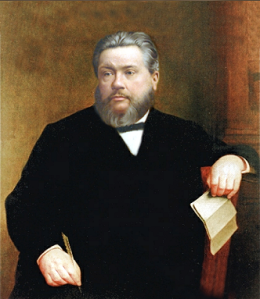
A Message Delivered on May 21, 1882 by C. H. Spurgeon
Related Posts:
The Perfect Law of God Must Stand Forever
The Heart of Every Real Christian is Most Reverent Towards the Law of the Lord
Misunderstanding Grace : “outside the law” is not the same as having no law
Misunderstanding Grace: Easy to miss the path and go far astray from the truth
Misunderstanding Grace – Antinomianism’s primary error is confusing Justification with Sanctification
Misunderstanding on the teaching of Grace